LIAM OTERO: "Edge of Illusions: Zoya Frolova, Janis Jakobsons, and Vasyl Mironenko" at Mriya Gallery, Tribeca (October 23 - November 5, 2025)
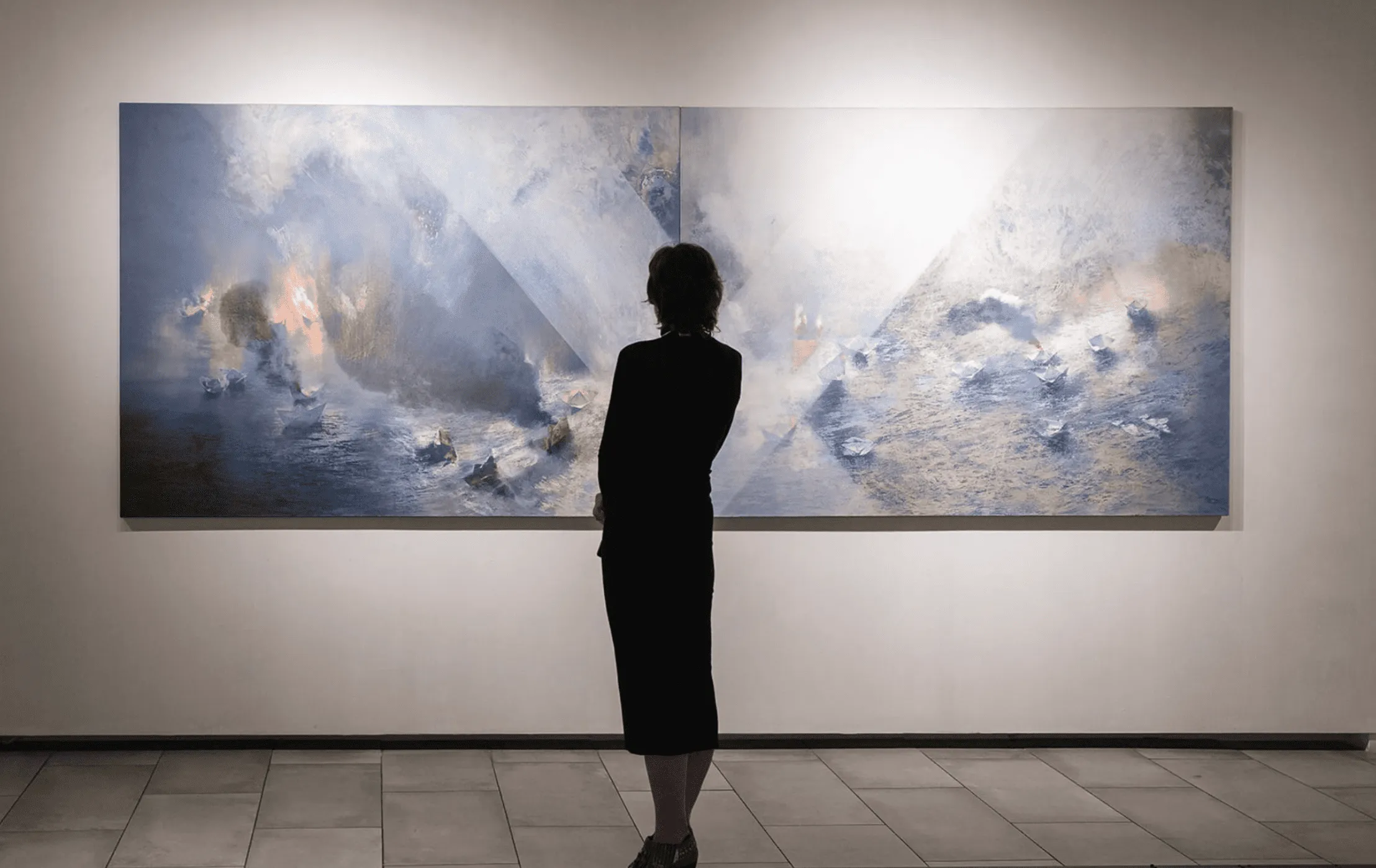
Mriya Gallery in Tribeca is one of my favorite specialty galleries - “specialty” here referring to a gallery that has a very particular focus in their exhibition programming. As a Ukrainian-owned gallery, Mriya’s mission is grounded in multidisciplinary shows with an eye towards positive social change (see my Whitehot Magazine review of Lora Robertson & Kevin Draper’s exhibition in May). Edge of Illusions was a meditative exhibition in which the artworks - much of which being more than a decade old - are suddenly charged with a new and invigorated meaning … unfortunately, in response to an avalanche of issues plaguing our world. Nevertheless, this is exactly the opportune moment for art to take the reins in enacting a genuine and effective difference in the face of crisis after crisis after crisis.
Janis Jakobsons (Latvian, b. 1959) and Zoya Frolova (Latvian-American, b. 1953, Kharkov, Ukraine) are husband & wife artists whose respective practices are distinct from one another, but are united in their cause for infusing a poetic introspection in the midst of the noise of the world. Most of the work in the exhibition are not new pieces, but are dated between 2012 and 2014. Edge of Illusions bravely responds to the question: How do creatives navigate the turbulent waters of conflict and loss? What emerges when imagination confronts the harsh realities of the modern world?
As Eastern European artists who have been in New York since 1995, a huge aspect of their work can be connected to Russia’s ongoing war in Ukraine and the political tensions that have emerged in neighboring countries like that of Latvia, Poland, and Belarus - just seeing some of the works dated from 2014 made me immediately draw a connection to Russia’s annexation of Crimea that year. When I spoke with Frolova and Jakobsons on the final day of the exhibition for a walkthrough, they confirmed that the Russia-Ukraine War can be associated with their works, but also to be mindful that many other issues in the world are just as pertinent: far-right political violence in the United States & Europe, climate change in the Anthropocene, growing disparities in the class system, post-capitalist technocracy, etc.
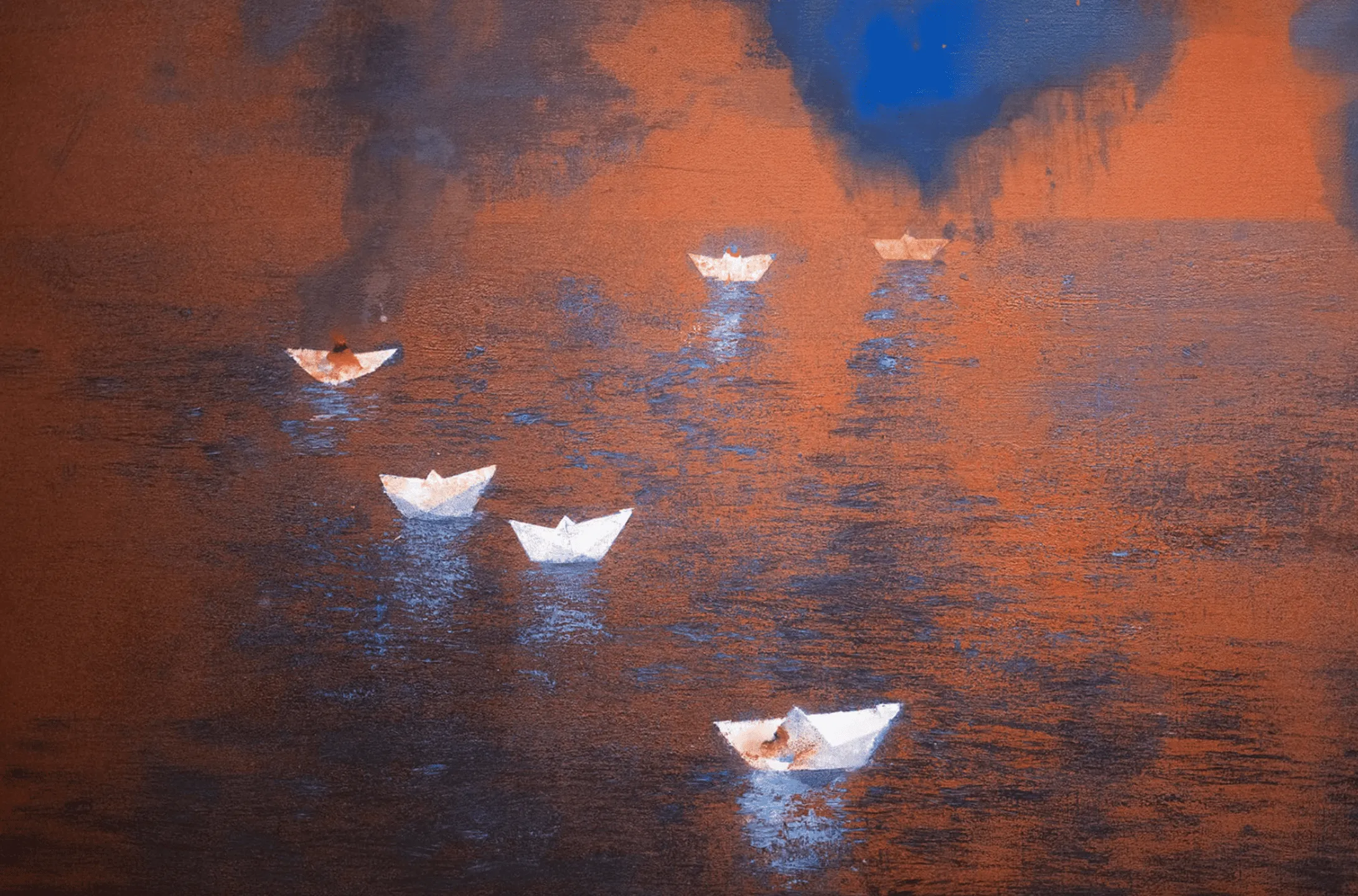
Frolova’s paintings and photographs are longitudinal compositions that regularly feature paper boats - a universal symbol of childhood play that also doubles as a metaphor for fragility. These paper ships float along the water, but yet one can recognize the physical delicacy behind their forms as some appear to be blown away by explosions or others sink into the watery depths. The use of rusty reds in her paintings is a stark contrast to the pale whites and blues, a signifier of loss of innocence, perhaps.
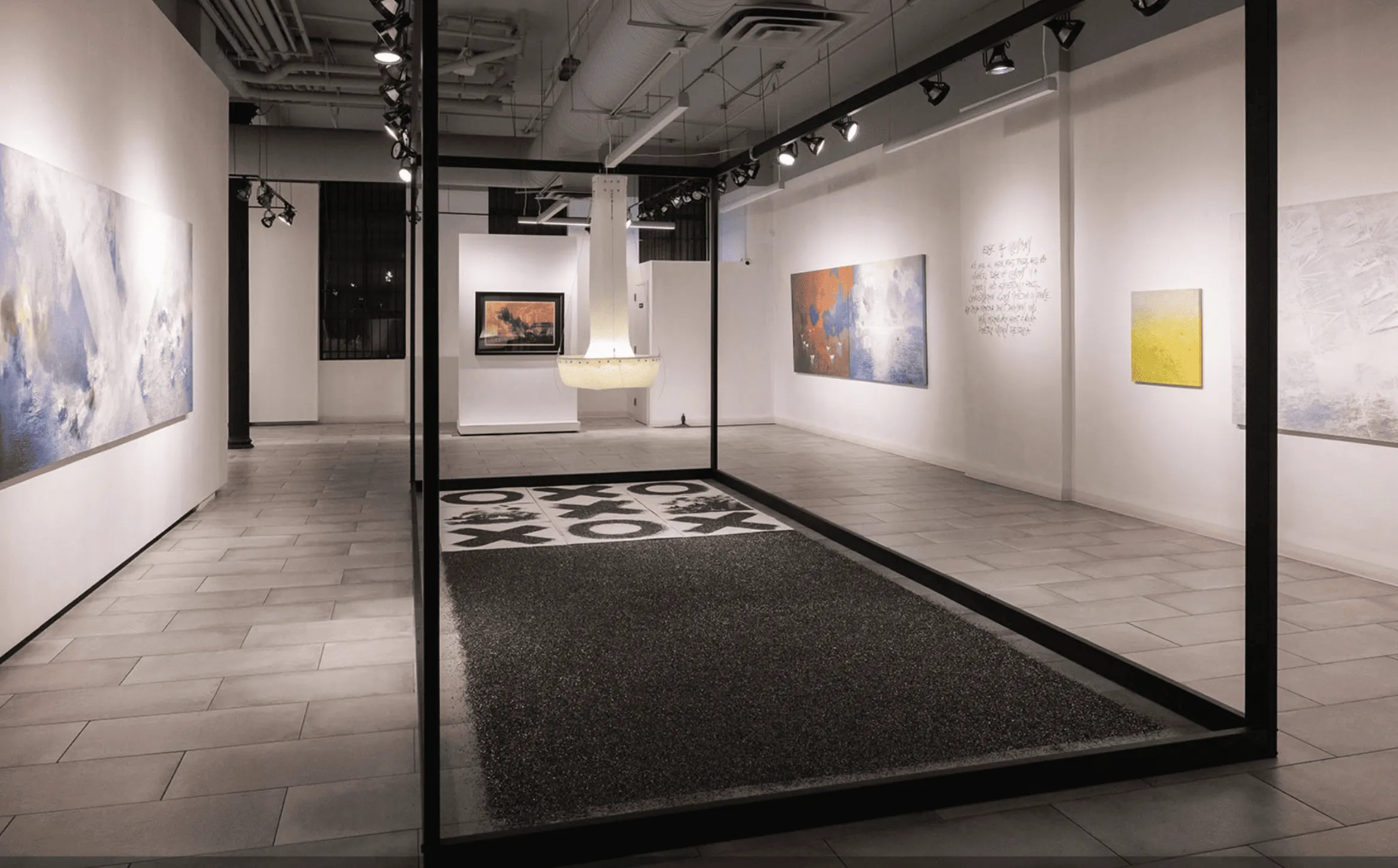
Though now it seems that Frolova’s practice is heading into another direction beyond painting and photography as she completed a site-specific installation in the center of the gallery. A floor-based tic-tac-toe grid is represented with strewn metal shavings whilst one of Jakobsons buoyant silicone sculptures quietly hangs over the grid. Jakobsons spoke at length with me about the seriousness children ascribe to games, but also towards the simultaneous lack of seriousness such real world issues like war and climate change are treated. There was another way in which I interpreted Frolova’s tic-tac-toe grid, again in the context of war, as being akin to the episode from Homer’s The Odyssey in which the hero Achilles plays a game of dice with another warrior, Ajax, as a respite during the Trojan War; the calm before the storm is another association I could glean here.
Jakobsons’s hanging silicone sculptures are interventionist, but not in a bombastic way. Instead, they descend like ghostly specters and cast the subtlest of shadows. Again, I am not just saying this because they are husband & wife artists, but Jakobsons’s art makes for a natural companion to Frolova’s work because of the silent solemnity attached to them that encourages more visual “listening” than “talking”.
I cannot possibly neglect to mention a third artist involved in the show - posthumously - who is in the title of my review: Vasyl Mironenko (Ukrainian, 1910 - 1964). Mironenko was a Soviet-era graphic artist whose etchings portray industrial zones. Azovstal Iron and Steel Works, which is located in Mariupol in Eastern Ukraine, was one of the largest and most active steel rolling industrial sites in the country that is depicted likely at its operative peak in Mironenko’s images, seen in the dramatically towering smokestacks that billow thick plumes of smoke (a recurring motif). Edge of Illusions is one of those exhibitions that expertly brought in the mid-20th Century artistic perspective in dialogue with contemporary works to underscore the endless cycles of activity underway with industrialization and the consequences it reaps; as it is, historians have been terming the 21st Century as the Fourth Industrial Revolution.
For the purposes of this exhibition, the lights would normally be turned on, except it just so happened that when I visited there was an electrical failure. I felt that the gallery and the artists devised a most clever solution for me to see the works as they placed candles in different sections of the gallery - of course, not too close to any of the works! The installation photos I include here were taken on the opening night, but I wanted to mention this as the darkness that enveloped the gallery which was punctuated by some glimmers of light really added even more emotional depth to Frolova and Jakobsons’ already potent works.
I don’t think answer-giving was the main point behind the works in Edge of Illusions, but rather question-generating. With the world being in a sort of free-fall state, how can anyone possibly conceive a solution when thoughtful questions are not being proffered as to what kind of change or solution needs to be made?
This exhibition was made possible as a collaboration between the artists, Mriya Gallery, Tukku Magi, and Rukh Art Hub.
Source: https://artandponder.substack.com/p/exhibition-review-edge-of-illusions?utm_campaign=post&utm_medium=web&triedRedirect=true